Shabti Figures
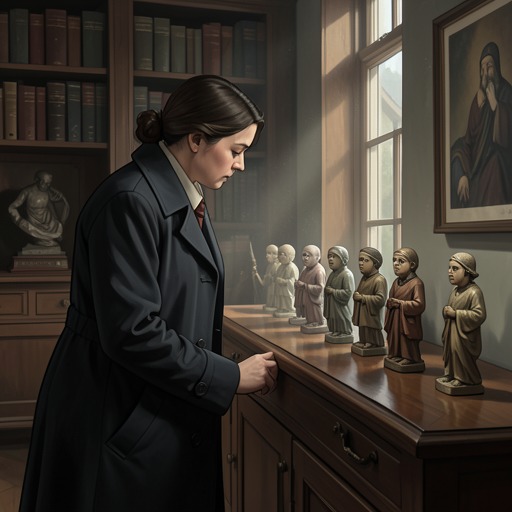
Theodosia and the Serpents of ChaosThe Shabti Figures are small clay statues whose altered appearance and disorder in their crates raise the possibility that they are active parts of Amenemhab’s curse. Their significance lies in the uncertainty they create: Theodosia finds them changed and displaced, but cannot establish whether they moved on their own or were handled by someone in the museum.
Material Form and Changing Appearance
The Shabti Figures are described as small clay figures. When Theodosia returns to the workroom, they have changed again: the statues are now exquisitely detailed, and the figures in one crate lie in a jumble rather than arranged as they had been left. The change is not merely a matter of where they sit. Their finer appearance makes the objects more conspicuous, while their disorder challenges the assumption that the workroom’s contents remain inert between visits.
The account offers no settled explanation for the change. Theodosia considers that the figures might have got up and moved, but frames this as a frightening question, not a witnessed fact. Her uncertainty keeps the Shabti Figures between two possibilities: ordinary artifacts that someone has disturbed, and objects implicated in supernatural activity.
Dream, Recovery, and Return to Work
The figures first press on Theodosia’s attention through a dream. After failing to persuade her parents to return to Egypt, she dreams that one is chewing on her ankle. On waking, she still feels the sensation, and for a moment the dream seems to have crossed into waking life. The apparent bite turns out to be Isis curled at her feet, gently working her claws against Theodosia’s ankle. Isis is no longer in the violent state Theodosia calls the Demon Isis.
The relief of finding Isis restored does not end Theodosia’s work with the Shabti Figures. She attributes the cat’s recovery to a mud bath and longs to remain with her, but says there is too much to do, beginning with the dirty figures. Before attending to them, she plans to make more amulets: she has given one to Stokes and another to Danver, and her supply is running low. The episode places the objects within a wider sequence of curse-related danger and protective preparations, even as Isis’s affectionate behavior briefly offers a respite from it.
Disorder in the Workroom
When Theodosia approaches the crates, she ignores a familiar punch of nausea. That physical reaction precedes any explanation of what she sees and signals that handling the objects has become charged with apprehension. At the nearest crate, the changed statues prompt her to compare their present arrangement with how they had been left. The discrepancy gives the possibility of movement a concrete basis, but not proof.
At the next crate, a dozen figures are scattered on the floor. Theodosia wonders whether this was the crate Henry had used for soldiers and whether he had carelessly left the figures out. She also considers that they might have climbed out themselves. A curator could have moved them, she reasons, and Clive Fagenbush comes to mind because she imagines him investigating. Yet that explanation also fails to satisfy her: even Clive Fagenbush treats artifacts with the utmost care. With each ordinary explanation undermined but none conclusively disproved, her unease grows.
Possible Role in Amenemhab’s Curse
Theodosia reasons that Amenemhab may have included the Shabti Figures in his curse because, in her view, he had included every other possible element. She imagines that the figures might rise and help bring down Thutmose III and Amenemhab’s enemies from within, comparing the hypothetical tactic to a Trojan horse. This is Theodosia’s theory, not a confirmed account of the figures’ purpose or powers. The passage makes the revenge logic seem plausible to her while preserving the distinction between suspicion and evidence.
The figures’ importance therefore rests on a double threat. They may be instruments of black magic, hidden among museum objects until needed; alternatively, their changed appearance and scattered positions may have an ordinary cause that Theodosia has not discovered. The scene ends with that uncertainty unresolved. Looking for answers, she crosses to the worktable where most of the stele have been laid out. The Shabti Figures have not yet acted in any directly witnessed way, but their presence has made the workroom itself feel unstable: careful arrangement can no longer be trusted as proof that the objects have stayed where they were left.